
Twelve Days for the Devotees: Understanding Ratha Jatra of Shree Jagannatha Temple, Puri

The Ratha Jatra of Shree Jagannatha Temple, Puri, falls each year on Ashadha Shukla Dwitiya, the second day of the bright fortnight of the Odia lunar month of Ashadha, a date fixed by the temple’s traditional panjika and not by the Gregorian calendar. In 2026, this tithi corresponds to July 16, and the reckoning has held across centuries of temple record, so the chariots move on the day the lunar calendar names, unmoved by whichever weekend suits a given year’s convenience.

This calendrical discipline sits uneasily against a newer, unfortunate practice. ISKCON chapters across cities in India and abroad now schedule their own Ratha Yatra observances on whichever weekend serves crowd logistics best, often at a considerable remove from the tithi the Puri temple itself observes. Odia commentators have long raised objections to this drift, holding that a festival anchored to a specific lunar date carries a theological logic distinct from that of a civic holiday, and that severing the observance from its calendrical anchor amounts to a departure from the tradition rather than an extension of it.
Scholarship on the festival’s antiquity offers firmer ground than legend alone. Hermann Kulke, drawing on the Madala Panji and inscriptional evidence, places the institutionalisation of the Jagannath cult and its chariot procession within the reign of Anangabhima III in the early thirteenth century, following the temple’s construction under Anantavarman Chodaganga Deva a century earlier. O.M. Starza’s architectural and art-historical study of the Puri temple locates the formal establishment of Ratha Yatra near the completion of the temple, around 1150, under the Eastern Ganga dynasty, a chronology broadly accepted among historians of medieval Odisha even as devotional literature places the festival’s origin in a more distant Puranic past.
The Ratha Jatra of Puri spans twelve days, counted from the day the chariots first roll to the day the deities return to the sanctum. Ratha Jatra proper occupies the opening day, seven days of residence at Gundicha Temple follow, Bahuda Jatra carries the deities homeward on the ninth day, and the closing arc unfolds across three further rites: Suna Besha on the tenth day, Adhara Pana on the eleventh, and Niladri Bije, the return to the sanctum, on the twelfth. Around this span, centuries of devotion, court history, and colonial misreading have layered a body of belief. Ten threads from that body are examined here, each set against the record where the record exists.
1. Gundicha Temple and Mausima Temple: A Persistent Conflation
Popular retellings often merge two distinct sites into one, calling Gundicha Temple the aunt’s abode. The two shrines serve separate functions in the narrative architecture of the festival.

Gundicha Temple stands as the janmabhoomi, the symbolic birthplace or garden house of Jagannath, and the deities occupy this temple through the seven-day residence that falls between Ratha Jatra and Bahuda Jatra. Mausima Temple, dedicated to the goddess Ardhasini, sits on the Bada Danda itself, along the return route, and the deities pause there for a matter of hours during Bahuda Jatra alone. Poda pitha, the baked rice cake beloved of Jagannath, is offered at Mausima Temple during this brief halt, and the confusion between the two sites likely stems from loose English renderings that gloss Gundicha as “aunt’s house,” a title that properly belongs to Mausima.
2. The Promise of the Faith: रथे च वामनं दृष्ट्वा पुनर्जन्म न विद्यते
A verse attributed to the Skanda Purana circulates widely among devotees and temple literature alike: rathe ca vāmanaṁ dṛṣṭvā punar janma na vidyate, rendered as the assurance that one who beholds the Lord upon the chariot gains release from the cycle of rebirth. Odia temple chroniclers cite the verse in accounts of the festival’s scriptural foundation, and regional press coverage returns to it each year as shorthand for the spiritual weight assigned to witnessing the chariots.

The verse belongs to the genre of phalashruti, the promised fruit of an act of devotion, a literary form common across the Puranas to encourage participation in pilgrimage and ritual. Placed alongside the Skanda Purana’s related claim that viewing the deities at Gundicha Temple confers the merit of a thousand horse sacrifices, the shloka functions less as a literal metaphysical guarantee and more as a devotional register meant to elevate the act of witnessing into an act of communion.
3. Hera Panchami and the Abhiman of Goddess Lakshmi
On the fifth day of the deities’ residence at Gundicha, ritual holds that Goddess Lakshmi, left behind at the main temple, sets out to find her consort. Finding him absent from the sanctum, she proceeds to Gundicha Temple in a palanquin, expresses her abhiman, her wounded pride, and in a gesture of protest orders a section of the Nandighosa chariot damaged before returning through the Nakachana gate.
The ritual carries the name Hera Panchami, hera meaning to look or search, and it dramatises marital estrangement as sanctioned temple theatre. Servitors representing the goddess perform the search each year, and the episode establishes a narrative thread that resolves only at the close of the twelve-day cycle, when reconciliation arrives through a different offering entirely.
4. Jagannatha’s Fondness for Poda Pitha and the Mausima Ritual
During Bahuda Jatra, as the chariots make their way back toward the main temple on the ninth day, the procession halts near Mausima Temple, and the deities are offered poda pitha, a baked confection of rice, coconut, and jaggery associated with rustic Odia kitchens rather than the elaborate Chappan Bhoga of the main sanctum. Tradition holds that the chariots do not resume their journey until this offering has been received.
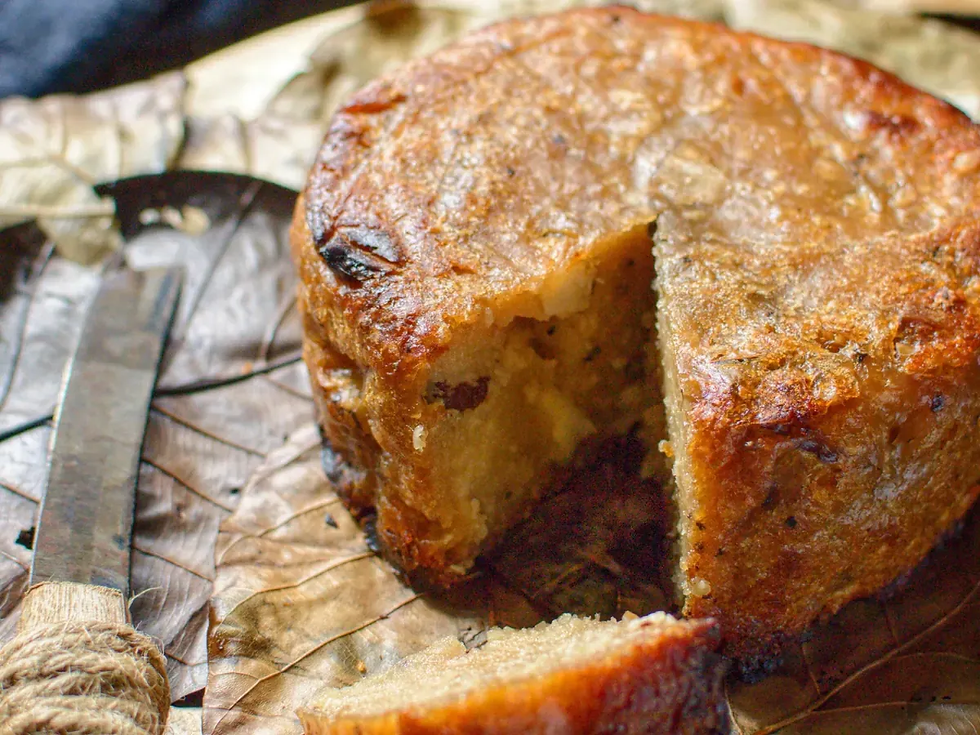
The ritual carries a resonance beyond taste. Poda pitha belongs to the everyday hearth of Odisha rather than to royal cuisine, and its offering at this single point in the yearly cycle allows the deity of the grandest temple in the region to partake, however briefly, in the food of ordinary households.
5. Chera Pahanra: Kanchi Abhijan, Purushottama Deva, and the Present Gajapati
Every year, before the chariots begin to move, the Gajapati of Puri descends from his throne, dons the attire of a sweeper, and cleans the platforms of all three chariots with a gold-handled broom, sprinkling the surface with sandalwood water. The ritual, called Chera Pahanra, carries a specific historical genesis tied to the fifteenth-century king Purushottama Deva.

Court chronicle and the Kanchi Kaveri Upakhyana, composed by the poet Purushottama Dasa, record that Purushottama Deva sought the hand of Padmavati, princess of Kanchi, and that a minister of Kanchi, having witnessed the king perform Chera Pahanra during a state visit, mistook the sweeping for the vocation of a lower caste. The Kanchi court withdrew the marriage proposal on those grounds, and Purushottama Deva, taking the slight as an insult against Jagannath himself, marched south. The Gajapati suffered defeat in the first campaign, returned to Puri to seek divine counsel, and in the second campaign, tradition holds, Jagannath and Balabhadra rode disguised among his forces. Kanchi fell, Padmavati was brought to Puri, and Purushottama Deva, keeping to his earlier vow to wed her only to a sweeper, married her himself at the following Ratha Jatra while performing Chera Pahanra once more.
The ritual endures under successive Gajapatis to the present day, performed now as a gesture of humility & surrender before the deity rather than as an act tied to caste hierarchy, a distinction increasingly foregrounded in temple scholarship and public commentary. The present Gajapati of Puri continues the tradition annually, and the act is read today as a statement that sovereignty itself bows before the Lord of the Universe.
6. The Myth of Salvation Beneath the Wheels
A persistent claim, repeated across colonial-era travel writing and still occasionally surfacing in casual retellings, holds that devotees historically threw themselves beneath the chariot wheels to attain salvation, and that pre-independence Puri witnessed hundreds or thousands of such deaths annually.
The earliest European source for this claim traces to the Franciscan friar Odoric of Pordenone in the fourteenth century, whose account was later embellished in the widely circulated Travels of Sir John Mandeville. Nineteenth-century missionaries and colonial administrators, most notably the chaplain Claudius Buchanan, amplified the image for audiences in Britain and America, framing the festival as a spectacle of fanatical self-immolation to argue for the necessity of Christian missions in India. Anthropologist Verrier Elwin, examining the claim in the mid-twentieth century, found no evidentiary basis for ritual suicide as an organised practice, and contemporary historians drawing on temple records and eyewitness accounts describe such incidents, where they occurred at all, as rare and accidental, arising from the press of enormous crowds rather than sanctioned devotional intent.
Vaishnava tradition itself preserves a counter-account: Chaitanya Mahaprabhu is recorded rebuking his disciple Sanatana Goswami for expressing a wish to end his life beneath the chariot, reminding him that a life dedicated to the Lord’s service belongs to that service, not to self-destruction.
7. The Colonial Word: Juggernaut
The English word juggernaut, denoting an unstoppable and destructive force, derives directly from Jagannath, and its passage into the language illustrates how observation filtered through missionary anxiety hardens into etymology. Buchanan’s early nineteenth-century writings popularised the term for British and American readers, casting the chariot procession as an emblem of what he considered Hindu excess, and the association with crushing, unstoppable weight persisted even as the word detached from its religious origin and entered general usage.
Scholars of the term’s history note a clear distinction between Jagannath, the deity and the tradition surrounding him, and Juggernaut, a construction of the British and American imagination assembled to serve a missionary argument. The word survives in English dictionaries today stripped of its theological content, retained purely as a metaphor for overwhelming force, a linguistic residue of a colonial encounter rather than a faithful transliteration of devotional practice.
8. Suna Besha and Adharapana: The Golden Attire and the Unseen Attendants
The tenth day of the cycle brings Suna Besha, the golden attire, when the three deities are adorned upon their chariots before Lions Gate with elaborate gold ornaments, a display counted among the most visually resplendent moments of the entire festival and one that draws crowds nearly as dense as the opening pull.
The eleventh day brings Adharapana. Large earthen pots of a sweetened drink, prepared from milk, cheese, sugar, banana, camphor, nutmeg, and black pepper, are raised on each chariot to the height of the deities’ lips.

After the offering, the pots are broken rather than distributed among devotees, an unusual departure from the customary sharing of prasad. Temple tradition holds that the offering serves the Parswa Devatas, minor deities stationed on the chariots to guard the procession, along with unseen spirits believed to gather along the Bada Danda during the festival. The breaking of the pots releases the drink for these attendant presences rather than for human consumption, marking Adharapana as one of the few Puri rituals directed explicitly toward the unseen rather than the visible congregation.
9. Lakshmi Narayana Kali and the Rasagola Offering
The twelfth day closes the festival with Niladri Bije, the return of the deities to the sanctum, and here the narrative thread opened at Hera Panchami finds resolution. Goddess Lakshmi, still aggrieved at having been left behind for the journey to Gundicha, bars Jagannath’s entry at the Singhadwara. A ritual exchange follows between a devadasi representing Lakshmi and a daitapati representing Jagannath, known as Lakshmi Narayana Bachanika or, in its more contentious register, Lakshmi Narayana Kali. Jagannath offers rasagola, and the gates open.
Temple scholars trace the rasagola offering to at least the eighteenth-century text Niladri Mahodaya, with some researchers citing references extending to the fifteenth-century Jagamohana Ramayana of Balarama Dasa, and servitor tradition places the custom considerably earlier still. Since 2015, Niladri Bije has additionally been observed publicly as Rasagola Dibasa, a day asserting Odisha’s claim to the sweet’s origin, a claim that received formal Geographical Indication recognition for Odisha Rasagola in 2019.
10. Religion Against Spirituality: What the Grand Road Finally Asks
Set side by side, these threads resist a single verdict of true or false. The chariot that pauses for poda pitha, the shloka promising release from rebirth, the king who kneels with a broom, the goddess who bars her own husband’s door: each carries a devotional logic that scholarship can contextualise without erasing. Where colonial observers converted spectacle into slander, as with the juggernaut myth, the record offers correction. Where servitor memory and Puranic citation diverge on a date or a source, as with the rasagola tradition, the record offers plurality rather than resolution.
What persists across all twelve days is a form of faith that operates independent of institutional definition. The Ratha Jatra asks little of doctrine and much of participation: the pull of the rope, the shimmer of gold before Lions Gate, the offering broken open for spirits no eye can confirm, the sight of the deity restored to the sanctum at last. Religion supplies the calendar, the sevaka lineage, and the precise hour for each rite. Spirituality supplies the reason lakhs still gather on the Bada Danda each year, regardless of whether every legend survives the archive intact. Faith, in the end, asks for presence before it asks for proof, and the Grand Road has drawn that presence for centuries.
References
Eschmann, Anncharlott, Hermann Kulke, and Gaya Charan Tripathi, eds. The Cult of Jagannath and the Regional Tradition of Orissa. New Delhi: Manohar, 1978.
Boulton, John. Review of The Cult of Jagannath and the Regional Tradition of Orissa, eds. Eschmann, Kulke, and Tripathi. Bulletin of the School of Oriental and African Studies 43, no. 2 (1980): 395–397.
Preston, James J. Review of Divine Affairs: Religion, Pilgrimage, and the State in Colonial and Postcolonial India, by Ishita Banerjee Dube. The Journal of Asian Studies 62, no. 1 (2003): 310–311.
“The Holy Sojourns of Jagannath: Reconsidering Pilgrimage through the Eyes of Deities.” Religions of South Asia.
Pasayat, Chitrasen, and others. Orissa Review, Car Festival Special Issue, July 2005. Government of Odisha.
Orissa Review, June 2006. Government of Odisha.
Orissa Review, July 2011. Government of Odisha.
Orissa Review, July 2013. Government of Odisha.


Comments