
Sarnath Climbs to UNESCO World Heritage Status

In the 48th session held in Busan between 19 and 29 July 2026, UNESCO’s World Heritage Committee is currently ratifying a new group of inscriptions, with thirteen sites receiving the status of World Heritage in this particular session. One of those is the Ancient Buddhist site of Sarnath, close to Varanasi in the state of Uttar Pradesh, which has its uniqueness based on one single, irreplaceable occurrence, namely that of the Buddha delivering his first discourse after gaining enlightenment at Bodh Gaya and reaching Sarnath where he taught the Dhammacakkappavattana Sutta.

The recommendation for the site from the Committee’s assessment team had been made earlier in the year, while the official recognition at Busan brings to a close an application process that began back in 1998, when Sarnath was added to India’s tentative list, and which took almost thirty years to reach its maturity in the nomination file of August 2025.
Sarnath’s Case for Outstanding Universal Value
The dossier of Sarnath is founded on the intensity and consistency of its archaeological record rather than on any monument. The place contains two zones of archaeology that cover almost two thousand years of history under the patronage of Buddhism: the erection of stupas, viharas, and temples by various royal dynasties, monasteries, and laity from the 6th century BCE to the time of the Maurya, Kushana, Gupta, and Pala dynasties. The most significant monuments of the place include the pillar of Ashoka, with its famous lion capital that became the symbol of the country.
The downfall of Sarnath started in the 12th century, following an attack on the site that was either blamed on the incursion of Qutb-ud-din Aibek or attributed to a combination of religious revolution followed by attacks. It was from that point that Sarnath disappeared into oblivion until it was rediscovered in the 18th century by Babu Jagat Singh. The recognition that UNESCO has bestowed on Sarnath is essentially of a palimpsest.

Its inscription thus brings the site into a fold of the four major sites of the Buddhist pilgrimage circuit, along with Lumbini, Bodh Gaya, and Kushinagar, all already recognized as world heritage sites or pilgrimage sites of international repute. This is the first time that any Buddhist site from the Indian state of Uttar Pradesh is inscribed on the list of World Heritage Sites; and from an Indian perspective, this takes the total number of sites of India above the forty-four sites that India had before, a total that comprised thirty-five cultural sites, seven natural sites, and one mixed site.
What Inscription Actually Confers
The terminology “World Heritage,” however, is a fluid one, so it would be prudent to understand explicitly what the inscription actually entails. Firstly, the inscription of a property does not imply any change in ownership or sovereignty; the property remains in its entirety within the purview of the Archaeological Survey of India and the government of Uttar Pradesh. The effect of the inscription is threefold.
Firstly, a property that has been inscribed according to the World Heritage Convention of 1972 will be qualified for International Assistance from the World Heritage Fund, and technical assistance from UNESCO advisory bodies such as ICOMOS for cultural properties.

Secondly, inscription requires the State Party to submit periodic reports regarding the site’s state of conservation; it becomes an outside and constant process of accountability, which is not normally created by a domestic regime alone; in cases where sites are threatened, they can be added to the List of World Heritage in Danger, which serves to attract more attention and resources.
Thirdly, and probably most importantly for Sarnath, inscription provides a form of symbolic capital that reliably turns into actual tourists. Previous inscriptions in other parts of India, such as the Ajanta and Ellora Caves as well as the more recent inscription of Maratha Military Landscapes in 2025, have historically led to an increase in visitors within just a few years after the declaration.

For the Buddhist circuit, in particular, the inscription at Sarnath is timed just right as there has been much work done by the Government of India on building tourism infrastructure between Bodh Gaya, Sarnath, Kushinagar, and Lumbini for pilgrims who come in from Sri Lanka, Thailand, Myanmar, Japan, and South Korea. The inscription at Sarnath, which is recognized as a World Heritage Site by UNESCO, provides it with the most globally recognizable point, which should speed up pilgrimage tourism as well as academic study.
The Broader Question: Preservation Through Visibility
A real tension in the heritage debate is one between visibility and vulnerability, as the very acknowledgment that makes it possible to attract conservation funds opens up the possibility of exposure to the risks of tourism and commercial development without regulation in the surrounding area, as well as the gradual deterioration brought about by pedestrian traffic. The Sustainable Tourism Program by UNESCO is indeed founded on this idea.

For the custodians of Sarnath, the next task for which they will have to prepare themselves is drafting or perfecting a management plan and creating buffer zones. The track record of India in this respect is somewhat inconsistent, but improving. And the actions taken by ASI of late – the installation of a plaque acknowledging the truth behind the rediscovery of Sarnath by the credit due to Jagat Singh and not to British antiquaries of the colonial period – gives some indication of curatorial seriousness that will be as important as the inscription.
Odisha’s Place on the Ledger
For those concerned about the development path that Odisha’s heritage has followed, the connection between the state and the World Heritage List is currently singular yet evolving. The Sun Temple of Konark, built in the thirteenth century in the shape of a chariot dedicated to Lord Surya under King Narasimhadeva I of the Eastern Ganga dynasty, has been part of UNESCO’s World Heritage List since 1984 and is to date the only such inscription from Odisha.
However, the list of tentative entries, the vestibule where all entries that will ever be inscribed have to pass through first, has increased significantly in the past year. In December 2025, for example, the Archaeological Survey of India made an entry to UNESCO’s World Heritage Centre for the inclusion of the “Diamond Triangle” of Odisha, namely Ratnagiri, Udayagiri, and Lalitgiri Buddhist complexes situated in Jajpur and Cuttack districts in India’s tentative list. The three complexes are nominated as a serial property that reflects the successive evolution of the Buddhism in the areas of Theravada, Mahayana, and Vajrayana over a period of more than a thousand years ago; Lalitgiri being one of the earliest Theravada sites in the area dating back to the second or third centuries BCE, Udayagiri being the complex of Mahayana and later Vajrayana and finally Ratnagiri is the great Vajrayana epicentre patronised during the Bhaumakara Dynasty.
The importance of this development in relation to the candidacy of Odisha is not coincidental either. The success of the listing of Sarnath over the past twenty-seven years serves as an example, but it also provides a warning that the process of nomination requires patience on behalf of institutions, thematic arguments through serial properties approach (which already has been done in case of the Diamond Triangle dossier, reflecting similar logic behind doctrinal succession), and the ability to plan ahead in the field of preservation. Each subsequent addition of a Buddhist site to the World Heritage List, whether Sarnath this year or, at some point in time, Diamond Triangle, adds another layer of context to evaluate Odisha’s Buddhist monuments because ICOMOS considers how a particular site compares to others inscribed on the List.
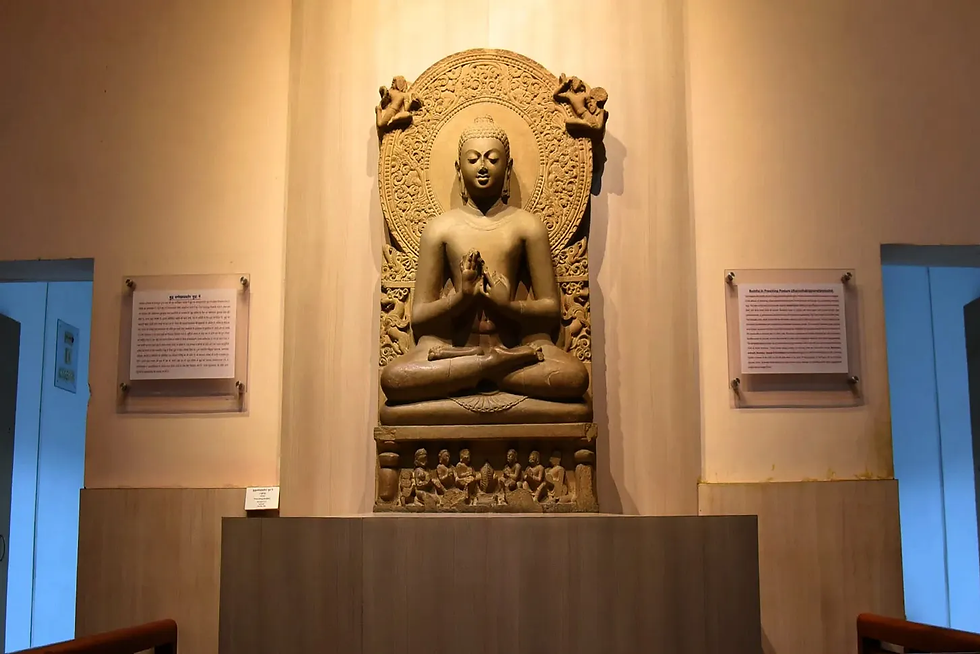
There is a kind of symmetry in this that bears reflecting upon for a moment: Sarnath is where the wheel of dharma turned for the first time, and its inscription this year marks a rotation, albeit a small one, in a wheel of institutional acknowledgement that started spinning in 1998 and required most of three decades to make one turn. In a wider context of the Indian heritage sector, what the inscription of Sarnath means is that the tentative list is not a waiting room but a document in which there is merit in compiling dossiers on the basis of academic research and comparison.
In case of Odisha, whose Diamond Triangle occupies the same position that Sarnath occupied a year ago, what matters is not celebration but preparation, the difference between the historical value of a site and its acknowledgment by the Committee being largely a question of documentation and good conservation practice.
References
UNESCO World Heritage Centre, “New Inscribed Properties: Nominations to be examined at the 48th session of the World Heritage Committee (2026),” whc.unesco.org.
UNESCO, “World Heritage Committee 2026,” unesco.org.
UNESCO, “World Heritage Committee gathers to protect humanity’s legacy,” unesco.org.
UNESCO, “The World Heritage Committee will examine new nominations and the state of conservation of inscribed sites,” unesco.org.
UNESCO World Heritage Centre, “Serial Nomination of Buddhist Triangle Sites of Odisha,” Tentative List entry.
World Heritage Site (independent tracker), “Ancient Buddhist Site, Sarnath, Varanasi,” Tentative Site record.
Deccan Herald, “’Ancient Buddhist Site, Sarnath’ submitted as India’s nomination to UNESCO for 2025-26 cycle,” 4 August 2025 (citing Union Culture Minister Gajendra Singh Shekhawat’s written response in Lok Sabha).
OdishaBytes, “3 Buddhist Sites Of Odisha Included In UNESCO’s Tentative World Heritage List,” citing correspondence from Lazare Eloundou Assomo, Director, UNESCO World Heritage Centre.
Buddhistdoor Global, “UNESCO Adds Odisha’s ‘Diamond Triangle’ of Buddhist Sites to India’s Tentative World Heritage List.”


Comments