
Power, Protest, Pattern: Analysing the History of Citizens' Movements Against Power in Independent India

Every polity carries within it a second constitution, unwritten, enacted in the street rather than in the legislature. Independent India’s second constitution has been drafted and redrafted since 1947, each generation adding a clause through fast, march, occupation, or armed insurgency, often in a grammar inherited directly from the freedom movement that preceded the Republic.
Gandhi’s satyagraha, non-cooperation, the courted arrest, the disciplined fast, supplied the vocabulary that citizens have turned since independence upon the very state that vocabulary helped create, a fact worth holding in mind as this essay proceeds: the Republic’s citizens learned to resist authority before they learned to inhabit it, and have never fully set the earlier lesson aside.
This essay offers a documented account of the country’s principal citizen movements against power since 1947, then turns to anthropology for a vocabulary adequate to what these movements share: their rituals, their symbols, their treatment of the body, and their relationship to memory. It names the issues around which Indian dissent has repeatedly organised itself and the outcomes such dissent has, and has not, achieved, before closing on why the youth-led movement now underway matters to the generation living through it, and not only to whatever textbook eventually records it.
A Chronicle of Revolt
I. Naxalbari and the Insurgent Left (1967–present)

In 1967, a peasant uprising in the Naxalbari region of West Bengal, led by cadres influenced by Maoist doctrine, inaugurated an armed revolutionary tradition distinct from the Gandhian one. The movement fractured and regrouped across five decades, sustaining insurgencies in parts of Chhattisgarh, Jharkhand, Odisha, and Andhra Pradesh under what security agencies term Left Wing Extremism. Unlike the movements catalogued elsewhere in this essay, the Naxalite trajectory tested the Republic’s tolerance for revolutionary violence rather than for peaceful dissent, and it remains, in diminished but unresolved form, the country’s longest-running internal conflict.
II. Chipko and the Emergence of Environmental Protest (1973)

In the Garhwal Himalaya, villagers, among them many women, embraced trees marked for felling by contractors, giving the Chipko Andolan its name, from the Hindi verb meaning to cling. The movement drew on prior Gandhian forest satyagrahas and established the practice of embodied, non-violent obstruction as an environmental strategy, later exported globally as a template for tree-protection activism.
III. The JP Movement and the Emergency (1974–1977)

Jayaprakash Narayan’s call for Sampoorna Kranti, total revolution, mobilised students in Bihar and Gujarat against corruption and price inflation, and eventually named Indira Gandhi’s government as its target. The government answered with the Emergency of June 1975, nineteen months of suspended civil liberties, press censorship, and the detention of opposition leaders. The 1977 general election, in which the Congress party lost power at the centre for the first time since independence, remains the clearest instance of an Indian electorate directly reversing an accountability crisis through the ballot.
IV. Dalit Assertion and the Ambedkarite Tradition (1956–present)

B. R. Ambedkar’s conversion to Buddhism in 1956, itself an act of civilisational protest against caste hierarchy, seeded a continuous tradition of Dalit political assertion. The Dalit Panthers, founded in Maharashtra in 1972 in explicit dialogue with the Black Panther movement, gave this assertion an organised, literary, and militant form. The tradition has continued through the rise of the Bahujan Samaj Party, periodic mass mobilisations against caste atrocity, most visibly following the 2016 Una flogging incident and the 2020 Hathras case, and remains among the most sustained rights movements in the country’s history, precisely because caste hierarchy has proven the most resistant to legislative correction alone.
V. The Anti-Mandal Agitation (1990)

The implementation of the Mandal Commission’s recommendation to extend reservation in government employment to Other Backwards Classes provoked upper-caste student protests across northern India in 1990, including self-immolations that shocked the national conscience. The episode inverted the usual pattern of protest against exclusion, becoming a protest against redistribution instead, and it remains a crucial case for understanding how accountability movements in India can as easily defend privilege as challenge it.
VI. Narmada Bachao Andolan (1985–present)

Medha Patkar’s movement against the Sardar Sarovar Dam on the Narmada river organised displaced Adivasi and farming communities against large-scale developmental displacement. Sustained through decades of litigation, hunger strikes, and submergence protests in which activists remained in villages as waters rose, the movement left the dam’s construction unaltered while embedding the language of rehabilitation and environmental impact assessment into subsequent Indian infrastructure policy, an outcome institutional rather than immediate.
VII. Anna Hazare and India Against Corruption (2011)

A Gandhian activist’s hunger strike at Jantar Mantar, prompted by the 2G spectrum and Commonwealth Games corruption scandals, drew hundreds of thousands into a campaign for a Lokpal anti-corruption ombudsman. The movement produced the Lokpal and Lokayuktas Act of 2013, and its energies gave rise, within two years, to the Aam Aadmi Party, an instance of protest energy converting directly into electoral institution.
VIII. The Nirbhaya Protests (2012)

The fatal gang rape of a young woman on a Delhi bus in December 2012 produced sustained, largely spontaneous protests demanding reform of the country’s laws on sexual violence. The Justice Verma Committee, constituted within weeks, led to the Criminal Law (Amendment) Act of 2013, broadening the legal definition of rape and introducing stricter penalties, a rare instance of rapid, protest-driven legislative reform on a matter of gendered bodily safety.
IX. Shaheen Bagh and the Anti-CAA Movement (2019–2020)
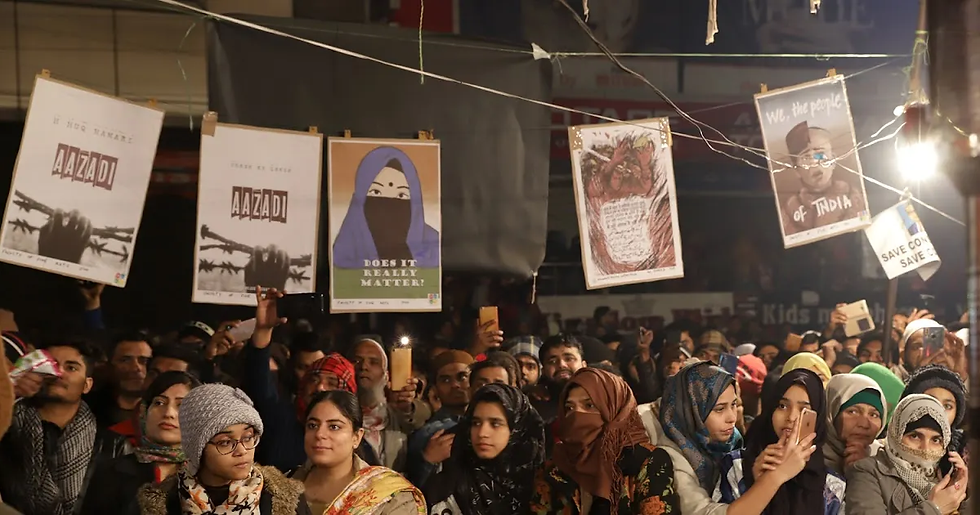
The Citizenship Amendment Act of December 2019 produced a sustained women-led sit-in at Shaheen Bagh in Delhi, alongside major confrontations at Jamia Millia Islamia and Aligarh Muslim University. The movement placed constitutional secularism, rather than economic grievance, at its centre, and was ended less by resolution than by the onset of the COVID-19 pandemic and subsequent lockdown, leaving the underlying dispute over citizenship and religion legally and politically unresolved.
X. The Farmers’ Agitation (2020–2021)

Farmers from Punjab, Haryana, and western Uttar Pradesh encamped at Delhi’s borders for over a year against three farm laws they viewed as favouring corporate agribusiness over smallholder livelihood. The laws were repealed in November 2021, marking one of the most unambiguous legislative reversals any mass movement in the Republic’s history has achieved.
XI. The Farmers’ Renewed Mobilisation Against Trade Liberalisation (2026, ongoing)

The farmers’ movement did not close with the 2021 repeal. In February 2026, the Samyukt Kisan Morcha, the same umbrella body that had led the border encampments five years earlier, organised a fresh nationwide protest and strike, this time against provisions of an interim trade agreement with the United States that farmer unions believed conceded too much on agricultural imports. Demonstrations spread from Punjab to Tamil Nadu, and a further gathering of farmers and industrial workers in Delhi in March 2026 renewed the long-standing demand for a legally guaranteed minimum support price, a demand the 2020–2021 movement raised without fully securing, even in victory. The renewed mobilisation illustrates a pattern anthropology recognises readily: a movement’s formal conclusion, the repeal of a law, rarely dissolves the underlying moral economy that produced it, and the same organisational infrastructure, leadership, and repertoire of protest can be reactivated by the state’s next perceived concession to outside interests.
XII. Adivasi Resistance to River-Linking and Extraction (2026, ongoing)

A distinct but structurally related protest has unfolded through 2026 among tribal and forest-dependent communities contesting displacement by large infrastructure and mining projects. In Madhya Pradesh’s Chhatarpur and Panna districts, resistance to the Ken–Betwa river-linking project, ongoing in smaller form since 2023, escalated sharply from April 2026, as residents of over forty villages objected to inadequate compensation, flawed consent processes, and the submergence of forest land within the Panna Tiger Reserve. Protesters organised what they termed Jal, Mitti, and Aakash Satyagrahas, oaths of resistance sworn over water, soil, and sky, alongside a Chula Bandh, a hearth-closure protest in which households refused to light their cooking fires, a ritual idiom of refusal distinct from anything in the Gandhian or farmer-movement repertoire and rooted instead in Adivasi domestic and agrarian symbolism. Some protesters marched toward Delhi while others camped inside the tiger reserve itself; authorities imposed prohibitory orders restricting movement near the protest sites, and by July 2026 police had forcibly ended the encampment.

A parallel and more violently contested instance has unfolded in Odisha, where Adivasi and Dalit residents of Kantamal in Kalahandi district have opposed the Sijimali bauxite mining project. In early April 2026, according to human rights organisations and local reporting, police forces surrounded the village before dawn, cut electricity, and carried out raids that villagers describe as intended to suppress opposition to the mining project, with several activists and farmers, including Lingaraj Azad and Suresh Sangram of the Navnirman Krushak Sangathan, subsequently arrested. Civil society groups, including the People’s Union for Democratic Rights, condemned the police action and called for the activists’ release. Both cases extend a lineage traceable directly to the Narmada Bachao Andolan: tribal communities asserting a right to remain on land the state has designated for submergence or extraction, met with a mixture of legal delay, incomplete rehabilitation, and, increasingly, direct police force.
XIII. The Cockroach Uprising (2026, ongoing)

The current education protests, catalysed by a Supreme Court remark comparing unemployed youth to cockroaches and inflamed by the 2026 NEET-UG paper leak and CBSE marking irregularities, have drawn a movement founded on social media into sustained occupation of Jantar Mantar, a hunger strike by activist Sonam Wangchuk, a march on Parliament met with police force, and spread to at least seven major cities. Its outcome, as of this writing, remains open, with the government offering rhetorical concession without the resignation protesters demand.
Anthropological Patterns
Read across a century and a half, these movements share formal properties that anthropology is well-suited to name.
1. Liminality and the Protest Site as Threshold
Victor Turner’s concept of liminality, the state of being between fixed social positions, describes with precision what happens at Jantar Mantar, Shaheen Bagh, or the Tikri and Singhu borders during occupation. Protesters step outside ordinary civic identity, student, farmer, mother, and enter a threshold space where new solidarities form. Turner termed the intense fellow feeling generated in such spaces communitas, a mode of relation stripped of ordinary hierarchy. Shaheen Bagh’s women, many with no prior activist history, described exactly this transformation, becoming political actors through the simple, sustained act of occupying a road. The farmers’ border encampments functioned identically, generating a temporary society with its own kitchens, libraries, and courts of opinion, separate from and in tension with the ordinary civic order it protested.
2. The Ritual Repertoire: Fast, March, Sit-in, Self-Endangerment
Indian protest draws on a limited and repeated set of embodied forms. The fast, inherited from Gandhi through Vinoba Bhave, Anna Hazare, Irom Sharmila, and now Sonam Wangchuk, converts the protester’s own body into the site of political stakes, a technique anthropologists studying hunger strikes elsewhere have described as the conversion of biological vulnerability into moral authority. The dharna, or sit-in, spatially claims contested ground through simple, prolonged presence. The yatra, or march, especially the attempted march on Parliament, ritually enacts the citizen’s claim to approach the seat of power directly, a claim state security routinely intercepts, itself a ritualised confrontation whose choreography, barricade, tear gas, baton, arrest, has become almost predictable across movements decades apart.
Self-immolation during the anti-Mandal protests represents this repertoire’s most extreme and troubling register, where the body serves as sacrifice rather than endurance. The 2026 Ken-Betwa resistance has extended this repertoire further, drawing on Adivasi rather than Gandhian symbolic vocabulary: the Jal, Mitti, and Aakash Satyagrahas swear resistance over the elements of a threatened landscape rather than over a political demand alone, and the Chula Bandh, the collective refusal to light a household’s cooking fire, converts the domestic hearth itself into a site of protest, a ritual form with no equivalent in the urban, largely male encampments this essay has otherwise catalogued.
3. Moral Economy and the Language of Legitimate Grievance
James Scott and, before him, E. P. Thompson, described a moral economy underlying peasant and popular protest: a shared, often unwritten sense of what subsistence, fairness, and legitimate authority require, violation of which licenses resistance even where no formal legal right has been breached. The farmers’ agitation invoked exactly such a moral economy, framing the market liberalisation of agriculture as a violation of an implicit compact between state and cultivator that predates and exceeds statute. The Cockroach movement performs the same manoeuvre around the examination system, treating it as a moral compact promising that effort will be rewarded rather than a mere administrative process, a compact experienced as betrayed rather than merely mismanaged.
4. Symbolic Inversion and the Reclamation of Stigma
Anthropologists of ritual, following Victor Turner and Mary Douglas, have long observed that societies periodically invert their own hierarchies of purity and pollution as a mechanism of critique. The Cockroach movement’s adoption of an insult as self-description is a textbook instance of symbolic inversion, converting an epithet of contempt into a badge of collective identity, a strategy with precedent in the global reclamation of terms like queer, and one that functions precisely because it makes the original insult impossible to repeat without now invoking the movement it created.
5. Collective Effervescence and the Manufacture of Solidarity
Durkheim’s concept of collective effervescence, the heightened emotional energy generated when a group assembles around a shared object of attention, explains why sustained physical co-presence, encampment rather than a single rally, so consistently produces the intensified solidarities visible at Shaheen Bagh, the farmers’ borders, and now Jantar Mantar. Encampment protest operates less as a tactic of visibility than as a ritual technology, one that generates and sustains the emotional bonds making prolonged confrontation with the state sustainable.
6. Subaltern Voice and the Politics of Who Is Heard
The subaltern studies tradition associated with Ranajit Guha and, from a different angle, Gayatri Spivak, asks whether and how the subordinated can speak within a discourse structured by the powerful. The recurring pattern in Indian protest is the initial dismissal of grievance as illegitimate, cockroaches without a place, rioters rather than citizens, anti-national rather than constitutional, followed by a struggle simply to be recognised as a legitimate speaking subject before any substantive demand can even be considered. This struggle for recognition is frequently the movement’s first battle, fought before its stated policy demand is engaged at all.
7. Memory, Martyrdom, and Repertoire Transmission
Each movement studied here explicitly cites its predecessors. Anna Hazare invoked Gandhi; the farmers’ unions invoked the Green Revolution’s broken promises to smallholders; Sonam Wangchuk’s fast consciously echoes Irom Sharmila and Hazare before him. This is what social movement scholars call repertoire transmission, the passing down of tactical and symbolic vocabulary across generations of activists who may share no direct organisational link. Anthropologically, it functions as a form of invented tradition, in Eric Hobsbawm’s sense, continually remade to feel ancestral even as its immediate content changes.
8. Gender and the Body as Contested Political Terrain
Nirbhaya and Shaheen Bagh both placed women’s bodies, as victims and as protesters, at the centre of national attention in ways caste- and class-based movements have historically struggled to achieve. The anthropology of gendered protest suggests that women’s occupation of public space carries a doubled transgression, against the state’s authority and against domestic norms restricting women’s presence in unsupervised public life, a doubled transgression that often intensifies both the moral force of the protest and the ferocity of the reaction against it.
Key Issues Across the Movements
Read together, these movements organise around a limited set of recurring axes. Economic distributive justice recurs from the JP Movement’s anti-inflation politics through the farmers’ agitation and its 2026 renewal against trade liberalisation to the Cockroach movement’s underlying unemployment grievance, suggesting that livelihood insecurity remains the single most reliable trigger of mass mobilisation in India, regardless of decade. Caste hierarchy recurs from Ambedkar’s conversion through the Dalit Panthers to the anti-Mandal agitation and its inverse, Dalit assertion for reservation, indicating that caste remains the axis on which Indian society is least willing to achieve a stable settlement, a hierarchy visible again in the Adivasi and Dalit residents of Kantamal facing police action over the Sijimali mining project.
Religious and communal identity, dormant in some movements, becomes central in others, most visibly the anti-CAA protests, revealing a fault line the Republic’s secular constitutional promise has managed but has not resolved. Environmental and land displacement, visible in Chipko, the Narmada Bachao Andolan, and now the Ken–Betwa resistance in Madhya Pradesh, exposes the tension between developmental ambition and the rights of communities who bear its costs without sharing proportionately in its benefits, a tension that recurs with striking structural continuity across four decades and two generations of the same forest-dependent communities. Gender and bodily autonomy, central to Nirbhaya and Shaheen Bagh, and visible again in the significant women’s participation at Ken-Betwa, reveal how questions of safety, land, and citizenship are experienced differently, and often more urgently, by women.
Civil liberties and the tolerance of dissent itself, tested most starkly during the Emergency and again in the state’s response to the anti-CAA, Ken-Betwa, and Cockroach protests, function as a kind of meta-issue, since a state’s willingness to permit protest at all determines whether any of the other grievances can be voiced in the first place. Institutional integrity, the corruption exposed by India Against Corruption, the examination fraud exposed by the Cockroach movement, recurs as a distinct category, since it concerns not the substance of policy but the basic trustworthiness of the mechanisms through which citizens are meant to access opportunity and justice.
Trade and agrarian sovereignty forms a further, sharpened axis in 2026, as farmer unions treat international trade concessions as a fresh instance of the same structural threat the 2020 farm laws once posed, extending a grievance about market exposure that predates any single piece of legislation.
Outcomes: A Typology
The outcomes of Indian protest movements resist a single narrative of either uniform success or uniform failure, and fall instead into several recognisable categories. Legislative reversal represents the clearest form of victory, achieved by the farmers’ agitation in 2021 and, in modified form, by the Nirbhaya protests through the 2013 Criminal Law Amendment. Electoral realignment represents a second category, visible in the 1977 defeat of the Congress party after the Emergency and in the Aam Aadmi Party’s formation out of the India Against Corruption movement, where protest energy is not answered directly but is instead converted into a new instrument of formal politics.
Institutional embedding without immediate victory describes the Narmada Bachao Andolan’s legacy, where the dam was built as planned yet the movement’s language of environmental and social impact assessment became a permanent, if imperfectly enforced, feature of subsequent policy. Repression without concession describes both the Emergency’s initial phase and the ongoing Naxalite conflict, where the state’s response has been coercive rather than negotiative, producing suppression rather than resolution.
Unresolved suspension describes the anti-CAA movement, ended by pandemic circumstance rather than settlement, its underlying legal dispute still pending. Co-optation describes a subtler outcome, visible in fragments across several movements, where the state absorbs a movement’s language, committees, review boards, promised reform, without conceding its core demand, a pattern the Cockroach movement’s organisers are currently watching for in the government’s rhetorical commitments to youth concerns.
Recurrence without resolution describes the farmers’ 2026 mobilisation with particular clarity: a movement that won its central demand in 2021 has been compelled to reassemble the same organisational infrastructure five years later, suggesting that a legislative repeal, however complete, settles a specific statute without settling the underlying moral economy that produced it.
Forced clearance describes the Ken-Betwa protest’s trajectory by July 2026, where sustained, ritually rich resistance ended through police action dismantling the encampment rather than through negotiation, an outcome closer to the Emergency’s coercive register than to the farmers’ eventual victory.
Ongoing and undecided describes the present moment for the education protests and for the Kantamal mining dispute in Odisha, both still without a settled category among these outcomes as this account is written.
What this typology suggests, anthropologically, is that Indian democracy processes accountability demands through a recurring cycle of assertion, ritualised confrontation, and partial closure, rarely resolving a grievance completely and rarely suppressing it completely either. The unwritten second constitution is never finished being drafted; each movement studied here understood itself, whether it named its predecessors explicitly or not, as the latest clause in a document the street has been writing since before the Republic itself existed.
Why the Youth Protest Outlives Its Moment
The Cockroach uprising will occupy a paragraph in future textbooks alongside the JP Movement and the farmers’ agitation. Its significance, however, is not exhausted by its eventual place in a syllabus. Several considerations argue for its importance to the generation now living through it, independent of how history ultimately records its outcome.

The movement teaches a generation that dissent is available to it before any other institution does. Civics classes describe the right to protest as a constitutional guarantee; the Cockroach movement has taught millions of students what that guarantee feels like in practice, from the first meme to the tear gas at Jantar Mantar. A right learned through witness or participation is retained differently, and more durably, than a right learned from a textbook clause.

It also supplies the next generation’s template for organising power. Every movement in this essay’s chronicle bequeathed its successors a repertoire, the fast from Gandhi, the encampment from the farmers, the elemental satyagraha from Ken-Betwa. The Cockroach movement bequeaths a repertoire built for an algorithmic public sphere: satire as mobilising idiom, a hashtag’s velocity substituting for a party’s organisational reach. Students now watching this unfold will carry that template into whatever grievance their own adulthood presents them.

The movement converts an abstract institutional failure into a personally felt stake. Unemployment statistics and examination-reform white papers rarely move a sixteen-year-old to the street. A leaked paper that cost a fellow student their future, or a Chief Justice’s dismissive remark, does. The movement has made the abstract architecture of opportunity, examinations, hiring, credentialing, into something a teenager can name, feel anger toward, and organise around, a form of political education no classroom civics module achieves as effectively.
It is testing, in real time and in public, whether India’s institutions still answer to the young. The movement’s outcome, resignation or no resignation, judicial review or judicial silence, will tell an entire cohort something formative about whether the Republic’s promises of accountability extend to them specifically. That lesson, whichever way it resolves, will shape how this generation votes, organises, and trusts institutions for decades, regardless of what any textbook eventually concludes about the movement’s historical significance.

Finally, the movement has already altered the vocabulary a generation uses to describe power. The reclaimed insult, cockroach, has entered common usage as shorthand for state contempt toward the young and unemployed, much as Shaheen Bagh entered the vocabulary of secular citizenship and the farmers’ borders entered the vocabulary of agrarian rights. Vocabulary of this kind outlives the specific protest that coined it, becoming a permanent addition to the country’s political idiom, available to the next movement this generation eventually leads.
Taken together, these considerations suggest that the movement’s importance to its own participants may prove more durable than its eventual textbook entry, since a textbook records what a movement achieved, while a generation’s lived experience of dissent shapes what it will attempt next.
References
Guha, Ranajit, ed. Subaltern Studies I: Writings on South Asian History and Society. Oxford University Press, 1982.
Spivak, Gayatri Chakravorty. “Can the Subaltern Speak?” In Marxism and the Interpretation of Culture, edited by Cary Nelson and Lawrence Grossberg. University of Illinois Press, 1988.
Turner, Victor. The Ritual Process: Structure and Anti-Structure. Aldine Publishing, 1969.
Turner, Victor. The Forest of Symbols: Aspects of Ndembu Ritual. Cornell University Press, 1967.
Douglas, Mary. Purity and Danger: An Analysis of Concepts of Pollution and Taboo. Routledge, 1966.
Durkheim, Émile. The Elementary Forms of Religious Life. Translated by Karen E. Fields. Free Press, 1912/1995.
Scott, James C. The Moral Economy of the Peasant: Rebellion and Subsistence in Southeast Asia. Yale University Press, 1976.
Thompson, E. P. “The Moral Economy of the English Crowd in the Eighteenth Century.” Past & Present, no. 50, 1971.
Hobsbawm, Eric, and Terence Ranger, eds. The Invention of Tradition. Cambridge University Press, 1983.
Jaffrelot, Christophe. Modi’s India: Hindu Nationalism and the Rise of Ethnic Democracy. Princeton University Press, 2021.
Guha, Ramachandra. India After Gandhi: The History of the World’s Largest Democracy. Ecco, 2007.
Omvedt, Gail. Dalit Visions: The Anti-Caste Movement and the Construction of an Indian Identity. Orient Longman, 1995.
Baviskar, Amita. In the Belly of the River: Tribal Conflicts over Development in the Narmada Valley. Oxford University Press, 1995.
Shiva, Vandana. Staying Alive: Women, Ecology and Survival in India. Zed Books, 1988.
Verma, J. S., Leila Seth, and Gopal Subramaniam. Report of the Committee on Amendments to Criminal Law. Government of India, 2013.
NPR. “India’s Gen Z ‘Cockroach People’s Party’ started as satire but is serious about change.” 20 July 2026.
CNN. “India’s CJP protests: Why Gen-Z’s political fury is boiling over in Delhi.” 22 July 2026.
The Wire. “CJI, Whose Comment on Cockroaches Led to a Movement, Says Court Doesn’t Have Time for Videos of Police Excess.” 22 July 2026.
Bloomberg. “India’s Major Farmer Group Revolts Against US Trade Deal.” 9 February 2026.
Bloomberg. “Indian Farmers Protest Against Modi’s Trade Deal With Trump.” 12 February 2026.
Bloomberg. “India Farmers Stage Fresh Protest in Delhi Against US Trade Deal.” 9 March 2026.
Newsgram. “Why Are Adivasis Protesting the Ken–Betwa Project in Madhya Pradesh’s Chhatarpur and Panna?” 15 April 2026.
The Indian Tribal. “Police Forcibly End Tribals’ Protest Against Ken-Betwa Link Project In Madhya Pradesh.” 19 July 2026.
Countercurrents. “Same Soil, Same Story: Adivasi blood on Odisha’s ground.” April 2026.


Comments